Mobile Broadband UK 2026: 4G/5G Home Broadband Alternatives to Fixed-Line FTTP
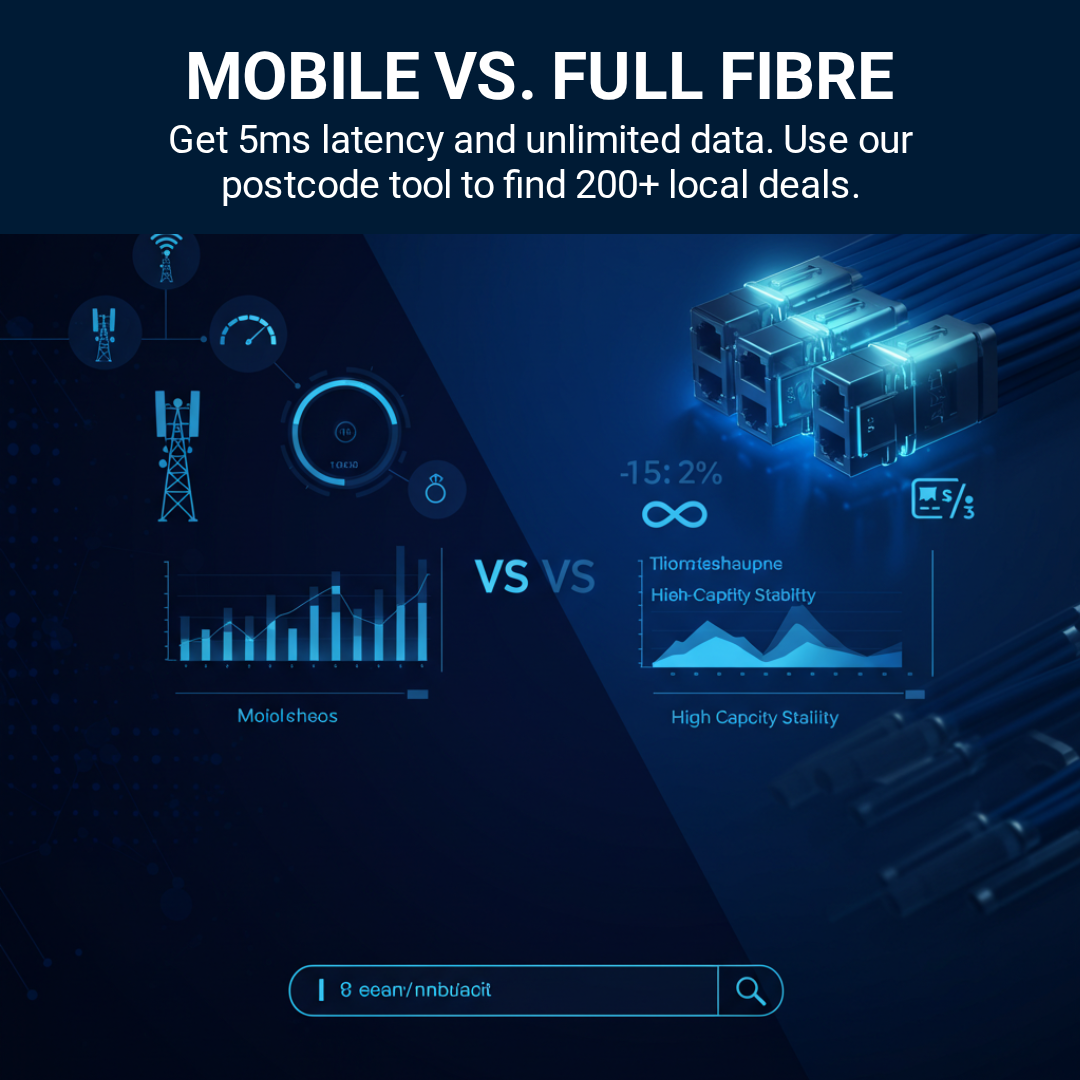
Mobile broadband delivers internet connectivity via 4G/5G mobile networks instead of traditional fixed-line infrastructure (fibre cables, copper lines). For premises lacking Full Fibre (FTTP) broadband access or experiencing extended deployment delays, mobile broadband represents viable alternative—particularly in rural areas where Openreach and CityFibre network explained coverage absent.
Yet mobile broadband introduces fundamental trade-offs: data caps (25–100GB typical monthly limits versus unlimited fixed-line), variable speeds dependent on network congestion, and higher latency (30–60ms versus 5–15ms FTTP) affecting best broadband for gaming viability. Understanding technology limitations, cost structures, and use-case suitability enables informed evaluation versus fixed-line alternatives.
What Is Mobile Broadband?
Mobile broadband uses 4G or 5G mobile networks (identical infrastructure serving smartphones) delivering internet access to homes and businesses. External antenna amplifies mobile signal; indoor router broadcasts Wi-Fi throughout premises.
Technology distinction:
Fixed-line broadband: Physical cables (fibre optic, copper, coaxial) running from street exchange directly to premises. Connection dedicated to single address—speeds and capacity not shared with neighbours.
Mobile broadband: Wireless transmission from mobile cell towers to premises antenna. Connection shares cell tower capacity with surrounding users (smartphones, tablets, other mobile broadband customers)—speeds degrade during peak congestion.
Practical implication: Mobile broadband speed variability higher than fixed-line. Evening peak hours (7–11pm) often experience 30–50% speed degradation as neighbourhood simultaneously streams, games, browses. Fixed-line experiences minimal peak degradation (congestion managed at exchange level, not customer level).
Use case positioning: Mobile broadband functions as:
Emergency backup: Temporary connectivity during fixed-line outage or installation delays.
Rural broadband solution: Areas lacking Full Fibre (FTTP) broadband or adequate FTTC speeds (<20Mbps).
Short-term rental accommodation: Rolling monthly contracts avoid long-term commitment unsuitable for temporary residence.
Contract Ending Soon?
How Mobile Broadband Works: Installation and Equipment
Installation process:
External antenna (mounted to building exterior, typically roof or high wall): Amplifies 4G/5G signal from nearest mobile cell tower. Antenna positioning critical—line-of-sight to tower improves signal strength significantly. Installer assesses optimal placement during site survey.
Indoor router: Receives amplified signal from external antenna via cable. Router broadcasts Wi-Fi throughout premises (identical to fixed-line router functionality). Supports wired ethernet connections if ultra-low latency required (best broadband for gaming households).
Power requirements: Router requires continuous power (standard power outlet). Antenna typically powered via cable from router (no separate power socket required).
Installation timeline: Typically 1–2 weeks from order to activation. Faster than fixed-line Full Fibre (FTTP) broadband installation (2–4 weeks typical for Openreach, CityFibre network explained, or regional altnets).
Installation costs: Many providers include installation free or minimal fee (£0–£50). Premium providers charging £100–£200 include professional site survey optimising antenna placement. Verify installation cost transparency before commitment—hidden fees common.
Router specifications: Mobile broadband routers typically support:
4G LTE (Long-Term Evolution): Maximum theoretical speeds ~150–300Mbps download, 50–100Mbps upload. Real-world speeds 20–80Mbps download, 10–30Mbps upload depending on signal strength and congestion.
5G (where available): Maximum theoretical speeds ~1Gbps+ download, 100–500Mbps upload. Real-world speeds 100–500Mbps download, 50–150Mbps upload. 5G availability limited to major cities; rural areas remain 4G-dependent throughout 2026–2028.
Wi-Fi standard: Typically Wi-Fi 5 (802.11ac) or Wi-Fi 6 (802.11ax, newer models). Wi-Fi 6 routers deliver superior device capacity (30–50+ simultaneous connections versus 20–30 for Wi-Fi 5).
Wired ethernet ports: 1–4 ports (depending on model) enabling wired connection for gaming consoles, work computers, smart TVs.
Mobile Broadband Speeds: 4G vs 5G Performance
4G LTE (2026 standard):
Typical speeds: 20–80Mbps download, 10–30Mbps upload.
Peak hour degradation: 30–50% speed loss during evening peak (7–11pm).
Latency: 30–60ms typical. Inadequate for competitive best broadband for gaming (esports require sub-20ms latency). Acceptable for casual gaming.
Best for: Casual streaming (1–2 4K streams maximum), browsing, light work-from-home (video conferencing marginal during peak congestion).
Coverage: Near-universal UK coverage (95%+ premises). Rural areas typically achieve 4G coverage; signal strength varies by distance from tower.
5G (emerging, limited availability):
Typical speeds: 100–500Mbps download, 50–150Mbps upload.
Peak hour degradation: 20–30% speed loss (less severe than 4G due to greater capacity).
Latency: 15–30ms typical. Marginally adequate for competitive gaming; latency variance still problematic versus fixed-line FTTP (5–15ms).
Best for: Multiple 4K streams, professional work-from-home, moderate content creation (upload speeds 10× faster than 4G).
Coverage: Major cities only (London, Manchester, Birmingham, Leeds, Glasgow coverage patchy). Rural areas lacking 5G throughout 2026–2028; national rollout targeting 2030+.
Comparison to fixed-line Full Fibre (FTTP) broadband:
FTTP 150Mbps: 140–155Mbps consistent (minimal peak degradation), 5–15ms latency, unlimited data. Superior to 4G mobile broadband across all metrics except deployment speed.
FTTP 500Mbps: 480–510Mbps consistent, 5–15ms latency, unlimited data. Superior to 5G mobile broadband for latency-sensitive applications and data-intensive households.
Strategic recommendation: If Full Fibre (FTTP) broadband available at postcode (verify via broadband availability checker), prioritise FTTP over mobile broadband regardless of installation timeline difference. FTTP's unlimited data, consistent speeds, and low latency justify 2–3 week installation wait versus mobile broadband's immediate activation.
Mobile Broadband Data Caps: Critical Limitation
Data allowances (2026 typical):
Entry-level packages: 25–50GB/month (£15–£25/month). Adequate for light browsing, email, occasional streaming. Insufficient for daily 4K streaming or work-from-home video conferencing.
Mid-tier packages: 100–200GB/month (£30–£40/month). Adequate for moderate streaming (1–2 hours daily), work-from-home, gaming (gaming data consumption low; downloads consume caps).
Premium packages: Unlimited data (£45–£60/month). Comparable pricing to fixed-line Full Fibre (FTTP) broadband without FTTP's performance advantages.
Data consumption examples:
4K Netflix streaming: 7GB per hour. Daily 2-hour viewing consumes 420GB/month—exceeds all but unlimited packages.
1080p Netflix streaming: 3GB per hour. Daily 2-hour viewing consumes 180GB/month—exceeds entry/mid-tier packages.
Zoom video conferencing: 2–4GB per hour (depending on resolution). 5 hours weekly work-from-home video calls consume 40–80GB/month.
Gaming: 50–100MB per hour (negligible). However, game downloads (50–100GB per title) consume monthly allowance instantly.
Overage charges: Exceeding data cap typically incurs £5–£10 per 10GB additional data. Households routinely exceeding caps accumulate £20–£50/month overage fees—negating mobile broadband cost advantage versus unlimited fixed-line.
Strategic implication: Data caps represent mobile broadband's critical limitation. Unless household consumption demonstrably <100GB/month (verified via current provider usage reports), mobile broadband unsuitable. Fixed-line Full Fibre (FTTP) broadband, Virgin Media review cable, or even FTTC deliver unlimited data justifying selection despite marginally slower activation.
Mobile Broadband Pricing: 2026 Cost Comparison
Entry-level 4G packages (25–50GB data):
Pricing: £15–£25/month
Contract: Rolling monthly (no commitment) or 12-month
Installation: £0–£50
Best for: Emergency backup, temporary accommodation, light browsing only
Comparable fixed-line alternative: cheap broadband deals FTTC 67Mbps unlimited data £25–£30/month. Fixed-line delivers superior value (unlimited data, consistent speeds).
Mid-tier 4G packages (100–200GB data):
Pricing: £30–£40/month
Contract: Rolling monthly or 12-month
Installation: £0–£100
Best for: Moderate streaming, work-from-home, rural premises lacking FTTP
Comparable fixed-line alternative: Full Fibre (FTTP) broadband 150Mbps via Zen Internet review (£28/month unlimited data) or Plusnet review (£30–£35/month). FTTP superior value unless FTTP unavailable at postcode.
Premium 5G packages (unlimited data):
Pricing: £45–£60/month
Contract: 12 or 24-month
Installation: £100–£200
Best for: Urban premises with 5G coverage, short-term rental avoiding long contracts
Comparable fixed-line alternative: Full Fibre (FTTP) broadband 500Mbps via Zen Internet review (£34/month) or gigabit via BT Broadband review (£44.99/month). FTTP dramatically cheaper with superior latency and consistency.
Cost-benefit verdict: Mobile broadband only justifiable if:
Fixed-line unavailable at postcode (verify via broadband availability checker).
Short-term accommodation (<12 months tenure) where rolling monthly contract flexibility outweighs performance trade-offs.
Emergency backup during fixed-line outage or Openreach strikes disruption.
Otherwise, fixed-line Full Fibre (FTTP) broadband delivers superior value across pricing, performance, and data allowances.
Mobile Broadband Contract Flexibility Advantage
Rolling monthly contracts:
Most mobile broadband providers offer rolling monthly agreements (no minimum commitment). Cancel anytime with 30-day notice—zero early termination fees.
Advantage: Flexibility for renters, temporary workers, students, or households awaiting Full Fibre (FTTP) broadband deployment at postcode. Switch to fixed-line immediately upon availability without penalty.
Disadvantage: Rolling monthly pricing typically £5–£10/month higher than 12/24-month contracts. Long-term mobile broadband users pay premium for flexibility not utilised.
Pay-as-you-go options:
Some providers offer true pay-as-you-go (purchase data bundles as needed versus recurring monthly subscription). Suitable for seasonal/occasional use (holiday homes, temporary project sites).
Pricing: £10–£20 per 10–20GB bundle. Cost-prohibitive for regular use; justified only for genuine sporadic access.
Contract comparison:
Mobile broadband: Rolling monthly (£30–£40 typical), 12-month (£25–£35), 24-month (£20–£30).
Fixed-line FTTP: Typically 18–24 month contracts. Early termination fees £50–£200. However, unlimited data and superior performance justify commitment for stable households.
Strategic consideration: If household tenure certainty <12 months, rolling monthly mobile broadband justifiable despite performance compromises. If tenure stable (homeowners, long-term renters), commit to fixed-line 18–24 month contracts capturing better pricing and performance.
When Mobile Broadband Makes Sense
Scenario 1: Rural premises lacking fixed-line FTTP
Full Fibre (FTTP) broadband unavailable, FTTC delivers <20Mbps, Project Gigabit deployment timeline >2 years. Mobile broadband (4G 30–60Mbps) delivers 2–3× speed improvement versus FTTC, justifying adoption.
Verify via broadband availability checker confirming no imminent FTTP deployment. Contact local authority confirming Project Gigabit voucher eligibility before committing to mobile broadband long-term.
Scenario 2: Temporary accommodation
Renters with <12 month tenure, students in term-time accommodation, temporary work assignments. Rolling monthly mobile broadband avoids 18–24 month fixed-line commitment unsuitable for short tenure.
Scenario 3: Emergency backup during Openreach strikes or outages
Fixed-line customers experiencing multi-day outages (network fault, Openreach strikes disruption) purchase mobile broadband router as temporary backup. Rolling monthly contract cancelled post-fixed-line restoration.
Scenario 4: Small businesses requiring rapid activation
Business premises lacking immediate fixed-line availability but requiring connectivity within 1–2 weeks (new office opening, pop-up retail, event venues). Mobile broadband activates faster than switching broadband providers or new fixed-line installation (2–4 weeks typical).
Scenarios where mobile broadband unsuitable:
Household with Full Fibre (FTTP) broadband availability at postcode—FTTP superior across all metrics.
Competitive gaming households requiring sub-20ms latency—mobile broadband 30–60ms latency inadequate for esports.
Heavy streaming households (multiple 4K streams daily)—data caps prohibitive; unlimited mobile broadband pricing exceeds FTTP cost.
Professional content creators requiring symmetrical uploads—mobile broadband uploads 10–30Mbps (4G) versus CityFibre network explained 900Mbps symmetrical.
Mobile Broadband Providers: Major UK Options
EE 4G/5G home broadband:
Coverage: Strongest 4G/5G network coverage UK-wide (EE operates largest cell tower infrastructure).
Pricing: £25–£50/month depending on data tier.
Speeds: 4G typical 30–80Mbps; 5G typical 100–300Mbps (London, major cities).
Advantage: Superior rural coverage versus competitors; most reliable 4G signal.
Disadvantage: Premium pricing versus smaller mobile broadband specialists.
Three 5G home broadband:
Coverage: Good urban 5G coverage; weaker rural 4G.
Pricing: £20–£40/month (competitive positioning).
Speeds: 5G typical 150–400Mbps (cities); 4G 20–60Mbps (rural).
Advantage: Competitive pricing; generous data allowances.
Disadvantage: Rural signal weakness; customer service mixed reviews.
Vodafone 4G/5G home broadband:
Coverage: Moderate nationwide; stronger urban than rural.
Pricing: £25–£45/month.
Speeds: 4G 25–70Mbps; 5G 100–350Mbps.
Advantage: Integration with Vodafone broadband review fixed-line services (potential bundling discounts).
Disadvantage: Rural signal gaps; customer satisfaction moderate.
Provider selection strategy: Prioritise network coverage verification at specific postcode over brand reputation. EE typically delivers strongest rural 4G signal; Three competitive urban 5G pricing. Verify signal strength via provider coverage checker before commitment—weak signal renders mobile broadband unusable regardless of pricing.
Conclusion: Mobile Broadband as Stopgap, Not Permanent Solution
Mobile broadband functions effectively as:
Temporary solution during Full Fibre (FTTP) broadband deployment delays or Openreach strikes disruption.
Emergency backup for work-from-home professionals requiring connectivity redundancy.
Short-term rental accommodation avoiding long-term fixed-line commitment.
Rural broadband access where fixed-line options remain FTTC <20Mbps or ADSL.
Yet mobile broadband unsuitable as permanent fixed-line replacement for stable households. Data caps, peak congestion degradation, latency variance, and premium unlimited pricing render mobile broadband inferior to Full Fibre (FTTP) broadband across use cases once FTTP available.
Strategic recommendation: Verify Full Fibre (FTTP) broadband availability via broadband availability checker before considering mobile broadband. If FTTP available, commit to fixed-line despite 2–4 week installation timeline—superior long-term value justifies short-term inconvenience. If FTTP unavailable, mobile broadband acceptable stopgap whilst monitoring Project Gigabit deployment progress.
Contract Ending Soon?
Tell us when your broadband contract ends and we'll email you the best deals available at your address, so you can switch penalty-free.