Video Gaming and Broadband: The Latest Data on Network Coverage in the UK
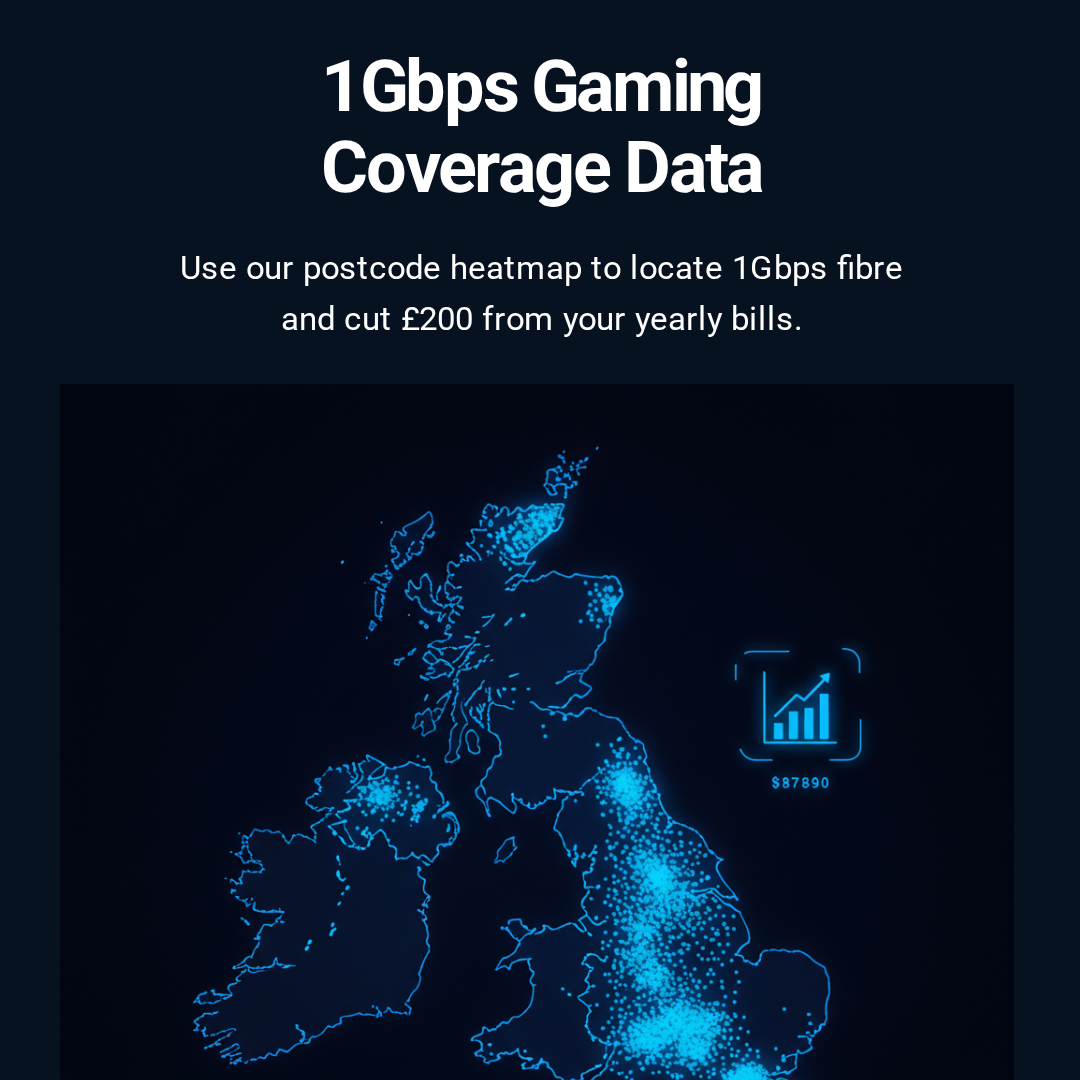
Thinkbroadband's Gaming Coverage Assessment
Thinkbroadband, the UK's leading independent broadband coverage analyst, released updated network coverage data (March 2025) specifically assessing gaming and streaming viability. The assessment differs from speed rankings—it evaluates which networks can actually deliver competitive gaming experience characteristics (low latency, low packet loss, consistent jitter).
Key distinction: Coverage ≠ Gaming viability. A premises may have broadband coverage but experience unplayable 50ms latency. Thinkbroadband's gaming assessment filters for networks delivering both coverage AND gaming-viable latency (<25ms for casual, <15ms for competitive).
Top findings:
- Openreach FTTP: 17.1 million premises with gaming-viable latency (5–15ms typical)
- CityFibre FTTP: 4 million premises with gaming-viable latency (5–15ms typical)
- Community Fibre FTTP: 1.5 million premises (London-focused, 5–10ms latency—best in category)
- Hyperoptic FTTP: 1.2 million premises (urban-focused, 5–12ms latency)
- Virgin Media HFC: 6.4 million premises with marginal gaming viability (10–25ms latency, variable)
- FTTC networks (BT, Sky, TalkTalk, Plusnet): 22+ million premises with acceptable gaming latency (10–30ms), but asymmetrical uploads limit streaming
- Copper/ADSL: 0.62 million premises with unplayable latency (>50ms, frequent disconnects)
- Fixed wireless/satellite: 0.15 million premises with poor gaming viability (30–700ms depending on technology)
Gaming coverage gap: Approximately 600,000 UK premises (0.62%) cannot realistically access gaming-viable broadband due to reliance on legacy copper (ADSL) or satellite. Project Gigabit targets eliminating this gap by 2032.
Contract Ending Soon?
What "Gaming Coverage" Actually Means
Thinkbroadband defines gaming-viable network coverage using three metrics:
1. Latency Consistency (Most Important for Gamers)
Gaming competitiveness depends on latency stability, not raw speed. A Valorant player at consistent 12ms ping outperforms one spiking 12–45ms.
Latency by network type:
- Full Fibre (FTTP): 5–15ms, highly stable (ping variance <3ms)
- Hybrid Fibre-Coax (Virgin Media HFC): 10–25ms, moderately stable (variance 5–10ms)
- FTTC: 10–30ms, stable (variance 3–5ms)
- Copper (ADSL): 20–80ms, variable (variance 10–50ms, weather-dependent)
- 5G/Fixed Wireless: 20–150ms, highly variable (spikes common during congestion)
- Satellite (geostationary): 500–700ms, unplayable (latency inherent to physics—signal travels 44,000km round-trip)
Thinkbroadband's gaming coverage metric: Premises with <20ms average latency qualify as "gaming-covered." This encompasses nearly 100% of fibre/FTTC premises (17+ million) and approximately 50% of fixed wireless premises (depending on tower proximity).
2. Upload Symmetry (Critical for Streamers)
Streaming whilst gaming requires upload bandwidth. FTTP networks offer symmetrical uploads (150Mbps upload on 150Mbps package); FTTC and HFC don't.
Streaming bandwidth requirements:
- 720p60fps: 6Mbps upload (achievable on FTTC 67Mbps plan with 10Mbps upload)
- 1080p60fps: 8–10Mbps upload (requires FTTC 150Mbps tier or FTTP)
- 4K streaming: 20–30Mbps upload (requires FTTP or premium HFC)
Coverage implications: Approximately 15 million UK premises lack 10Mbps upload bandwidth (ADSL/basic FTTC), making simultaneous 1080p streaming + competitive gaming impossible.
3. Packet Loss and Jitter (Invisible but Critical)
Packet loss >0.3% and jitter >20ms cause gameplay stuttering, "ghost bullets," and enemy teleportation. Fibre networks: <0.1% packet loss. Copper: 0.5–3.0%. Satellite: 0.3–1.0% (inherently unreliable).
Thinkbroadband's assessment: Fibre (FTTP) networks span 22+ million premises meeting all three gaming metrics. FTTC covers 22+ million with acceptable latency but limited upload. Copper covers 0.62 million unsuitably.
Regional Gaming Coverage Disparities
Thinkbroadband's data reveals stark regional differences in gaming-viable coverage:
Metropolitan (London, Manchester, Birmingham, Glasgow):
- FTTP coverage: 70–80% of premises
- Average latency: 8–12ms
- Upload bandwidth: 150+ Mbps on most tiers
- Gaming assessment: Excellent; competitive esports viable
- Streaming assessment: Flawless 1080p60fps simultaneous with gaming
Urban (Leeds, Edinburgh, Cardiff, Bristol):
- FTTP coverage: 50–70% of premises
- FTTC coverage: 20–30% of premises
- Average latency: 12–18ms (fibre) or 20–25ms (FTTC)
- Gaming assessment: Good; competitive esports viable on fibre tier
- Streaming assessment: 1080p viable on FTTP; 720p on FTTC
Town/Suburban (populations 10k–100k):
- FTTP coverage: 30–50% of premises (increasing via Project Gigabit)
- FTTC coverage: 40–60% of premises
- Average latency: 15–25ms
- Gaming assessment: Marginal; casual gaming smooth, competitive play at disadvantage (20–25ms higher than metro gamers)
- Streaming assessment: 720p viable; 1080p requires FTTP tier
Rural (populations <10k):
- FTTP coverage: 15–30% of premises
- FTTC coverage: 30–50% of premises
- Fixed wireless: 10–20% of premises
- Copper/satellite: 5–10% of premises
- Average latency: 25–100ms (highly variable)
- Gaming assessment: Poor; latency spikes common, unsuitable for competitive play
- Streaming assessment: Gaming-only streaming viable; simultaneous gaming + streaming unplayable
Remote (populations <5k, Islands, Highlands):
- Fibre coverage: <10% of premises
- Fixed wireless: 30–50% (20–40ms latency, unreliable)
- Copper: 20–40% (50–150ms, frequent outages)
- Satellite: 10–20% (500ms+, unplayable)
- Gaming assessment: Unplayable for competitive; casual turn-based games only
- Streaming assessment: Impossible without severe lag/buffering
Provider-Specific Gaming Coverage Ratings
Openreach (Resold via BT, Sky, TalkTalk, Plusnet):
- Gaming coverage: 17.1 million premises with <20ms latency
- Strengths: Nationwide dominance; nearly all UK postcodes served
- Weaknesses: FTTC in older fibre areas has asymmetrical upload (limits streaming); customer service varies by reseller
- Gaming verdict: Excellent for competitive gaming; adequate for streaming if FTTP tier chosen
- Coverage rating for gamers: 9/10 (availability) | 7/10 (latency consistency, due to mixed FTTP/FTTC mix)
Virgin Media (HFC/cable network):
- Gaming coverage: 6.4 million premises with 10–25ms latency
- Strengths: Very fast download speeds (500+Mbps); good upload symmetry on premium tiers
- Weaknesses: Higher latency variance than fibre; HFC topology less stable during peak hours
- Gaming verdict: Good but not optimal; latency variance disadvantages esports; streaming excellent
- Coverage rating for gamers: 6/10 (availability) | 6/10 (latency consistency—cable slightly worse than fibre)
CityFibre (Direct deployment + Project Gigabit contracts):
- Gaming coverage: 4 million premises with 5–15ms latency
- Strengths: Modern network design optimises for low latency; rapidly expanding via government subsidy
- Weaknesses: Limited geographic footprint (primarily Midlands, South West, Wales)
- Gaming verdict: Excellent; competitive esports viable; best-in-class latency consistency
- Coverage rating for gamers: 7/10 (availability) | 9/10 (latency consistency—equals FTTP gold standard)
Community Fibre (London-focused FTTP):
- Gaming coverage: 1.5 million premises (nearly all London) with 5–10ms latency
- Strengths: Best-in-class latency (modern network); rolling monthly contracts; aggressive pricing
- Weaknesses: Geographic limitation (London only); limited brand awareness
- Gaming verdict: Best for London gamers; esports-ready infrastructure
- Coverage rating for gamers (in-London): 10/10 | Out-of-London: 0/10
Hyperoptic (Urban-focused FTTP):
- Gaming coverage: 1.2 million premises (university towns, affluent suburbs) with 5–12ms latency
- Strengths: Excellent latency; modern infrastructure; symmetrical uploads
- Weaknesses: Limited to high-density urban areas; premium pricing
- Gaming verdict: Excellent; competitive esports viable
- Coverage rating for gamers (in-coverage): 9/10
5G/Fixed Wireless (EE, O2, Vodafone):
- Gaming coverage: ~1 million premises with 20–150ms latency (highly variable)
- Strengths: No installation required; portable; available where fibre doesn't reach
- Weaknesses: Latency unpredictable; congestion during peak hours; packet loss higher than fibre
- Gaming verdict: Casual gaming viable; competitive gaming unreliable
- Coverage rating for gamers: 4/10 (availability outside fibre areas) | 3/10 (latency consistency)
Satellite (Starlink, Viasat, traditional geostationary):
- Gaming coverage: ~150,000 premises with 20–700ms latency
- Strengths: Available in areas with no alternatives; Starlink improving dramatically
- Weaknesses: Traditional satellite unplayable (500ms+ latency); Starlink still new/expensive; weather-dependent
- Gaming verdict: Traditional satellite unplayable; Starlink acceptable for casual gaming, marginal for competitive
- Coverage rating for gamers: 2/10 (traditional) | 5/10 (Starlink)
Gaming vs Streaming: Different Coverage Requirements
Gaming primarily requires:
- Low latency (<20ms for casual, <15ms for competitive)
- Low packet loss (<0.3%)
- Consistent jitter (<10ms variance)
- Moderate download bandwidth (5–10Mbps)
Streaming primarily requires:
- High upload bandwidth (8–30Mbps depending on resolution)
- Consistent throughput (no spikes/drops)
- Moderate latency (doesn't matter if upload consistent)
Implication: A gamer can succeed on 30Mbps FTTP with excellent latency. A streamer fails on 500Mbps FTTC with 5Mbps upload, despite higher speed.
Thinkbroadband's assessment separates these: some networks excel at gaming latency but lack upload symmetry; others have speed but inconsistent latency. For gamers choosing providers, latency consistency trumps marketed speeds.
Coverage Gaps: Unserved Gaming Premises
0.62% of UK premises (approximately 180,000 homes) cannot access gaming-viable broadband:
- Served by copper ADSL only: 80–150ms latency, frequent weather-related disconnects
- Served by geostationary satellite only: 500ms+ latency, unplayable for any competitive gaming
- Awaiting Project Gigabit deployment: Timelines 2027–2029; no interim solution suitable for gaming
For affected households:
Check Project Gigabit timeline: Ask local authority for confirmed deployment date. If 2026–2027, waiting may be pragmatic (endure 1–2 years for transformative upgrade vs switching to interim suboptimal solution).
Interim solution: Starlink: Low-earth orbit satellite (20–40ms latency) sufficient for casual/competitive gaming. Cost: £600 upfront + £79–£179/month. Better than copper/geostationary satellite.
Interim solution: Fixed wireless: Quickline, Airband, Voneus offer 20–40Mbps with 25–40ms latency. Pragmatic bridge if Starlink unavailable or too expensive.
Not recommended: Upgrading gameplay expectations to match copper capability. 80–150ms latency makes competitive multiplayer unplayable; streaming impossible. Accept gaming unavailability until better infrastructure arrives.
Practical Recommendations: Choosing a Gaming-Viable Provider
Step 1: Check available networks at your postcode
Use broadband availability checker. Identify which networks serve your premises:
- Full Fibre (FTTP): Openreach, CityFibre, Community Fibre, Hyperoptic, others
- FTTC: BT, Sky, TalkTalk, Plusnet
- Cable (HFC): Virgin Media
- Fixed wireless: EE, O2, Vodafone 5G
- Satellite: Starlink, traditional satellite
Step 2: Prioritise by gaming latency profile
- Competitive esports goal: Choose FTTP provider (Openreach, CityFibre, Community Fibre, Hyperoptic). Target 150Mbps+ tier for headroom. Expected latency: 5–15ms.
- Casual gaming + streaming goal: Choose FTTP (symmetrical upload essential). Target 300Mbps+ for upload headroom. Expected latency: 5–15ms.
- Gaming + streaming simultaneously: Must choose FTTP (FTTC/HFC insufficient upload). Target 500Mbps+.
- Budget-constrained casual gaming: FTTC acceptable (10–25ms latency). Avoid ADSL/satellite.
Step 3: Compare pricing via cheap broadband deals
Once network identified, use comparison to find best-value provider tier within that network.
Step 4: Test actual latency pre-commitment
Run speed test via broadband speed test during peak hours (7pm–11pm) to confirm latency stability. Request trial period if available (Community Fibre offers 30-day trial; others offer 14-day cancellation).
Step 5: Review customer service (Which? rankings)
For gaming-critical connections, ISP customer service matters. Zen Internet (77% satisfaction) and Plusnet (76%) rank highest. Virgin Media (62%) and TalkTalk (54%) rank lowest.
The Broader Picture: Gaming Coverage Evolution (2026–2028)
Current trajectory:
- 2026: 60% of UK premises have FTTP access (up from 45% in 2024); gaming-viable coverage expanding rapidly
- 2027: 75% of UK premises have FTTP access via Project Gigabit + commercial deployment
- 2028: 85%+ of UK premises have FTTP access; rural/remote areas begin deployment
- 2030+: 95%+ target (residual 5% extremely remote areas where infrastructure cost exceeds ROI)
Implication for gamers: If you're currently in rural area with poor gaming coverage, the situation improves dramatically 2027–2028 via Project Gigabit. Temporary frustration is worth enduring if deployment confirmed within 24 months. For urgent gaming needs now, Starlink or fixed wireless provides pragmatic interim solution.
Contract Ending Soon?
Tell us when your broadband contract ends and we'll email you the best deals available at your address, so you can switch penalty-free.